Measure what
wins.
Athletic development runs on guesswork. Telios changes that with objective performance data: a coaching methodology your program uses today, and wearable measurement technology that arrives for founding partners.
Five steps. No equipment.
Every gym, every sport.
The OPD framework starts entirely without technology. No equipment to purchase, no systems to install. It begins with a fundamental change in how coaches observe, measure, and develop athletes, and it works with what schools already have.
- step / 01Define Metrics
Name what matters before you measure it.
Coaches and athletes identify the specific, observable variables that decide outcomes in their sport: contact point, timing, body positioning, movement efficiency.
What changesPractice shifts from general repetition to targeted, intentional work. Everyone knows what good looks like.
- step / 02Structured Observation
Watching becomes analysis.
Coaches move from passive watching to active analysis. Repetitions are broken down deliberately. Patterns are identified and named.
What changesA shared language emerges between coach and athlete. Evaluation becomes consistent across sessions and across staff.
- step / 03Feedback Loops
Action and understanding close the gap.
Immediate, specific feedback after every set of reps. Coach-guided correction, athlete self-assessment, and peer observation each play a role.
What changesAthletes develop self-awareness and ownership of their development. The correction lands while the rep is still warm.
- step / 04Track Progress
Improvement becomes visible.
Simple tools (a notebook, a whiteboard, a basic spreadsheet) record metrics over time. Sessions are compared. Plateaus are identified early.
What changesCoaches have evidence to support their decisions. Athletes see a curve, not an opinion.
- step / 05Performance Translation
Practice connects to competition.
Practice metrics get tied to game outcomes. Athletes see the direct link between what they refine and what happens when it counts.
What changesTraining becomes purposeful. Engagement and buy-in increase. The gym starts asking better questions.
Every step is technology-free. It works in any gym, on any field, with any sport. The power is in the methodology, not the equipment. The technology comes next, and it comes only after the framework has roots.
Built for every level of the game.
From school districts to professional programs, Telios gives coaches and athletes objective performance data that drives winning.
Athletic development still relies on guesswork.
The coaching environment lacks the structure to make feedback objective, repeatable, and measurable. The problem isn’t bad coaching. It’s a system that has barely changed in decades.
Feedback varies by who’s watching.
Athletes get notes based on what a coach saw in the moment, which depends on attention, angle, and fatigue. The next coach sees something different.
Progress is felt, not proven.
There is no data trail showing what improved or why. Coaches struggle to communicate performance gaps in terms athletes can act on.
Talented athletes plateau.
The mechanics holding them back are invisible without structured measurement. Programs lose ceiling on the very athletes they recruited hardest.
What the framework teaches manually,
the Telios System captures automatically.
The Telios technology layer already exists: a working wireless prototype is in active validation at Rice University, with a patent pending. Early Founder Options are open for programs ready to move before general availability. Contact us about the program.
- step / 01
Player wears the glove.
A featherweight sensor fits inside a standard match glove. No tape, no straps, nothing the athlete has to think about between rallies.
20g · IP67 · 12-hour battery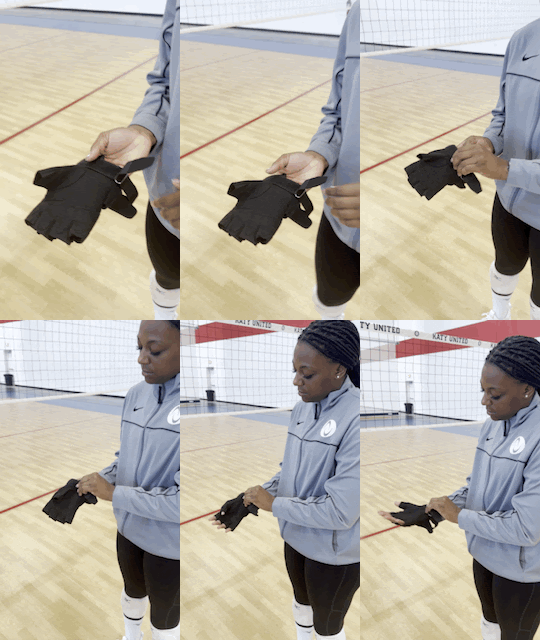
- step / 02
The net knows where it is.
A Bluetooth net system maps the plane in three dimensions. Every contact above it is captured against a single, calibrated reference frame.
court-wide coverage · auto-calibrated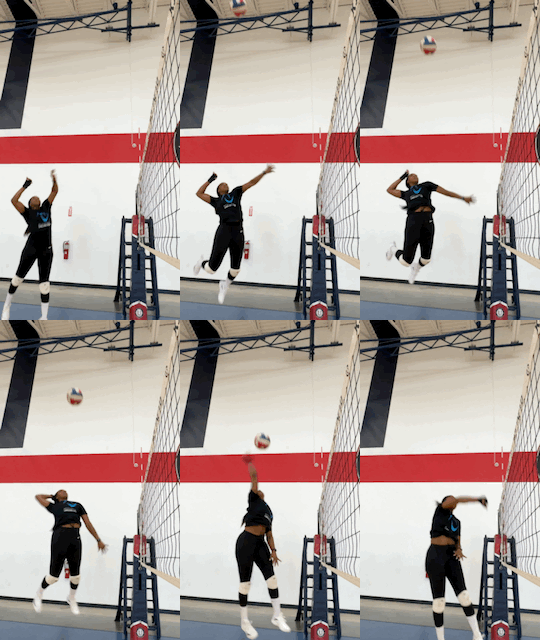
- step / 03
Data hits the sideline.
Reach height appears on a coach's tablet within 50 milliseconds. Mid-rally, mid-rep, mid-recruit visit. No replay, no spreadsheet.
iPad / iPhone · live + recorded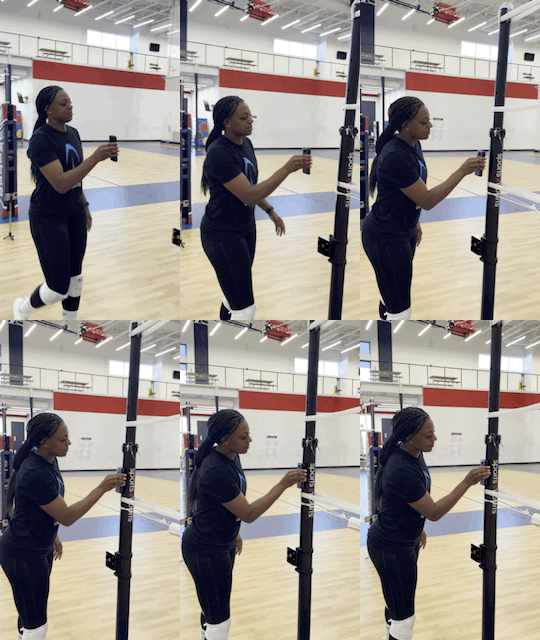
- step / 04
Compare across reps.
Sessions roll up to athlete profiles. Athletes roll up to programs. Programs roll up to seasons. Subjective stops here.
athlete-level history · program rollups
The wearable is the entry point. The network is the asset.
Every rep captured is the first structured record of what athletes actually do at the point of contact, across thousands of programs.
Objective, real-time feedback.
Every athlete is measured against their own baseline, not a coach's memory of last week's rep.
A common, objective standard.
Compare execution across athletes and programs on real data, not just highlight reels.
Longitudinal development data.
A record of what actually changes performance, built rep by rep across a season and beyond.
Every rep feeds a dataset nobody can rebuild without the installed base. Hardware can be copied. The network cannot.
The outcome already happened.
You can’t coach it.
Every sport measures outcome data: what the ball did. Kills, points, where it landed. But the outcome already happened. You can explain it. You can’t coach it.
What matters is execution data: what the athlete did in the instant of contact, height, angle, force, timing. The last moment anything is under the athlete’s control. Everything after is physics.
Contact isn’t something you point a camera at.
It’s an event in time, lasting milliseconds. A camera records thousands of frames and can’t tell which one was contact. The moment has no data because nothing marks when it happened.
A precise timestamp of contact makes execution data measurable for the first time, and tells every other source, including video, which instant to read.
Stop guessing.
Start measuring.
Twenty minutes with the Telios team. We’ll walk through program fit, identify the right sport and staff to lead, and outline what a founding partnership looks like for your school. Bring your AD if you can.
Athletic directors, head coaches, club directors, and program leaders at every level: high school, club, NCAA, and professional. Investor and partner conversations welcome.
Framework fit, target sport, staff readiness, STEAM crossover, and the founding-partner timeline through the technology layer.
Roster size, season timing, and who else inside the building needs to be in the room before a partnership is formalized.